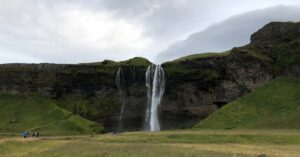
Towering out of the ocean water near Iceland’s most southern village are a number of distinctive stone formations. While a geologist would tell you that these are naturally occurring basalt sea stacks, the traditional folklore of the area offers a different view. Legend has it that these cliffs are actually trolls who were turned to stone long ago.
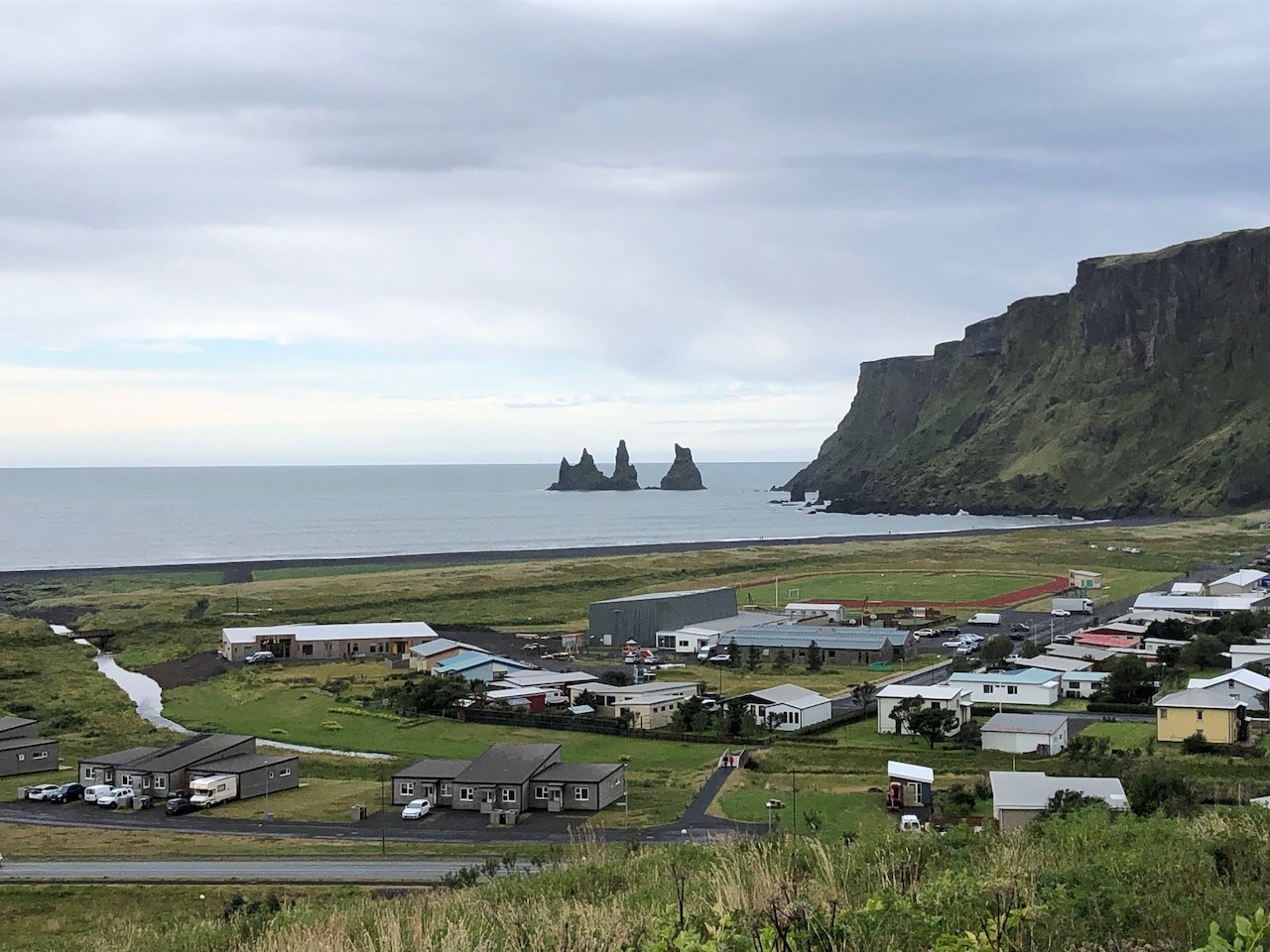
The stone trolls in the sea
Names
The village in question is Vík í Mýrdal, commonly referred to just as Vík. The sea stacks sit in the water by the base of a mountain named Reynisfjall, not far from Vík’s famed black sand beach. Collectively, the stacks are known as Reynisdrangar – though each formation has its own specific name:
- Langsamur (“Slow” in English) is the largest one and has three pillars.
- Skessudrangur (“Troll-woman’s pillar”), also called Háidrangur (“Tall Pillar”), is a single column that’s quite tall and thin.
- Landdrangur (“Land Pillar”) is the stack closest to shore.
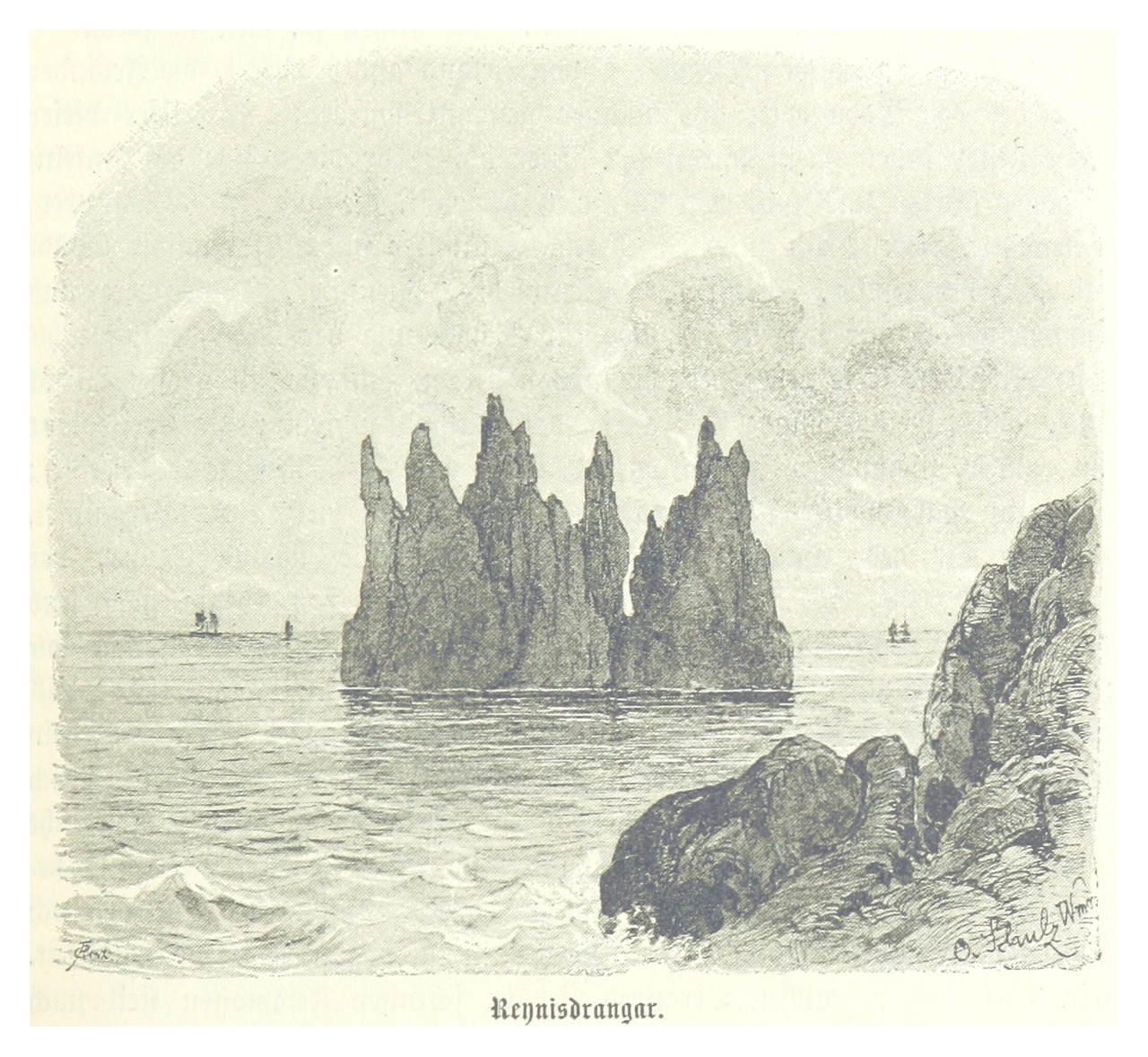
1889 illustration of the three formations (Source: Wikimedia Commons)
The Legend
If you look online, you’ll find a few variations of the legend concerning these sea stacks. The version I heard in Iceland and often see on websites is that two trolls attempted to pull a ship to shore. However, they got turned to stone at sunrise after losing track of time. For some reason, the ship experienced the same petrifying fate. Less frequently, you’ll find webpages stating that there were three trolls.
Unfortunately, most references online don’t provide a source for the legend. Perhaps some people were simply told about the trolls while visiting, as I was, and it just keeps getting passed along. As such, I was eager to learn if there were any pre-internet references to the tale. Though I couldn’t find anything in English, I did locate an Icelandic source.
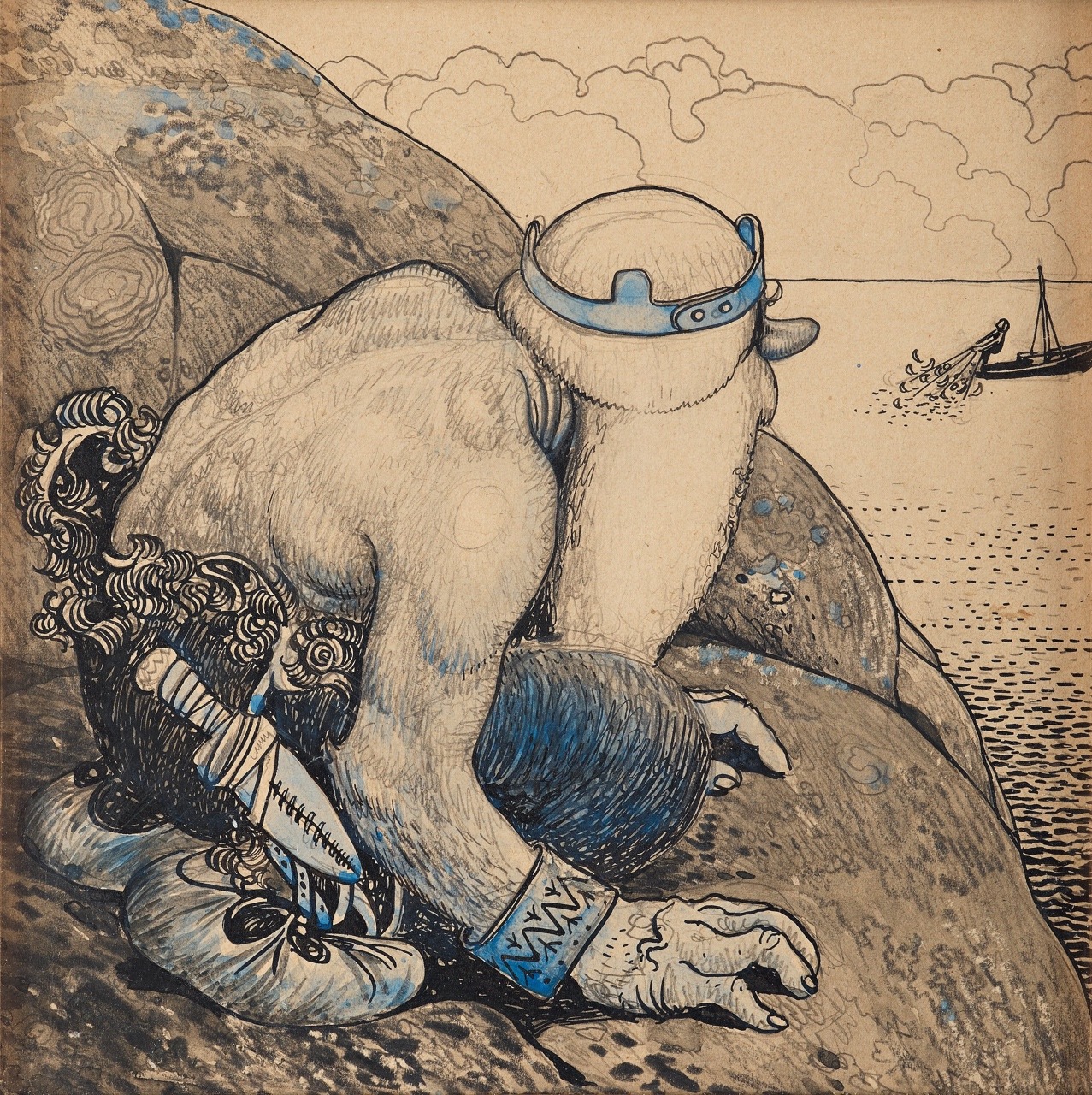
Troll art by John Bauer (Source: Wikimedia Commons)
The 1899 book Þjóðsögur og munnmæli (Folktales and Oral Tradition) by Jón Þorkelsson provides the following tale, sourced from an 1865 manuscript written by Runólfs Jónssonar of Vík. I used a number of online tools to arrive at the following translation:
There has been an oral tradition about this sea stack, but I have not been able to get a fuller account of it than what I shall now tell. A large ship is said to have docked in Þórshöfn, which was east of Reynistjall, where it is now called Þórshöfnarfjara. It was wrecked by a storm, and it was put in there for repairs. While the repairs were going on, a great troll-woman came to the crew and asked them for a ride. This was supposed to be a king’s ship, but it was said that the king’s son was there alone to fetch his bride, but it is not clear where the ship came from or where it was going. Still, this king’s son is supposed to have had the bride with him, so this ship must have been on its way home. It is now to be noted that the king’s son is supposed to have refused the troll-woman a ride, but she said that it would be no harm to them if she could wade out to them when they set off. When the crew had repaired what they thought necessary, they set out from the harbor and headed south along the mountain. But when they had come to the end of the mountain, they saw where the troll-woman was going, and she then set out into the sea, called to the crew and asked them to wait, but they refused. And when she saw it was impossible to reach them, she declared that they and their ship would turn to stone. But then the king’s son replied that she would also turn to stone, and that they should both become cursed. Another version states that a great giant followed the troll-woman, and he is therefore supposed to be the Landdranger. This is now supposed to be the origin story of the sea stacks in front of Reynisfjall.
It would thus seem that the oldest written version of the story bears a number of broad similarities to the tale as it’s told today. Specifically, there are indeed two trolls (one of which was referred to as a giant) and a sailing ship. They all end up being turned to stone at the end, resulting in the sea stacks.
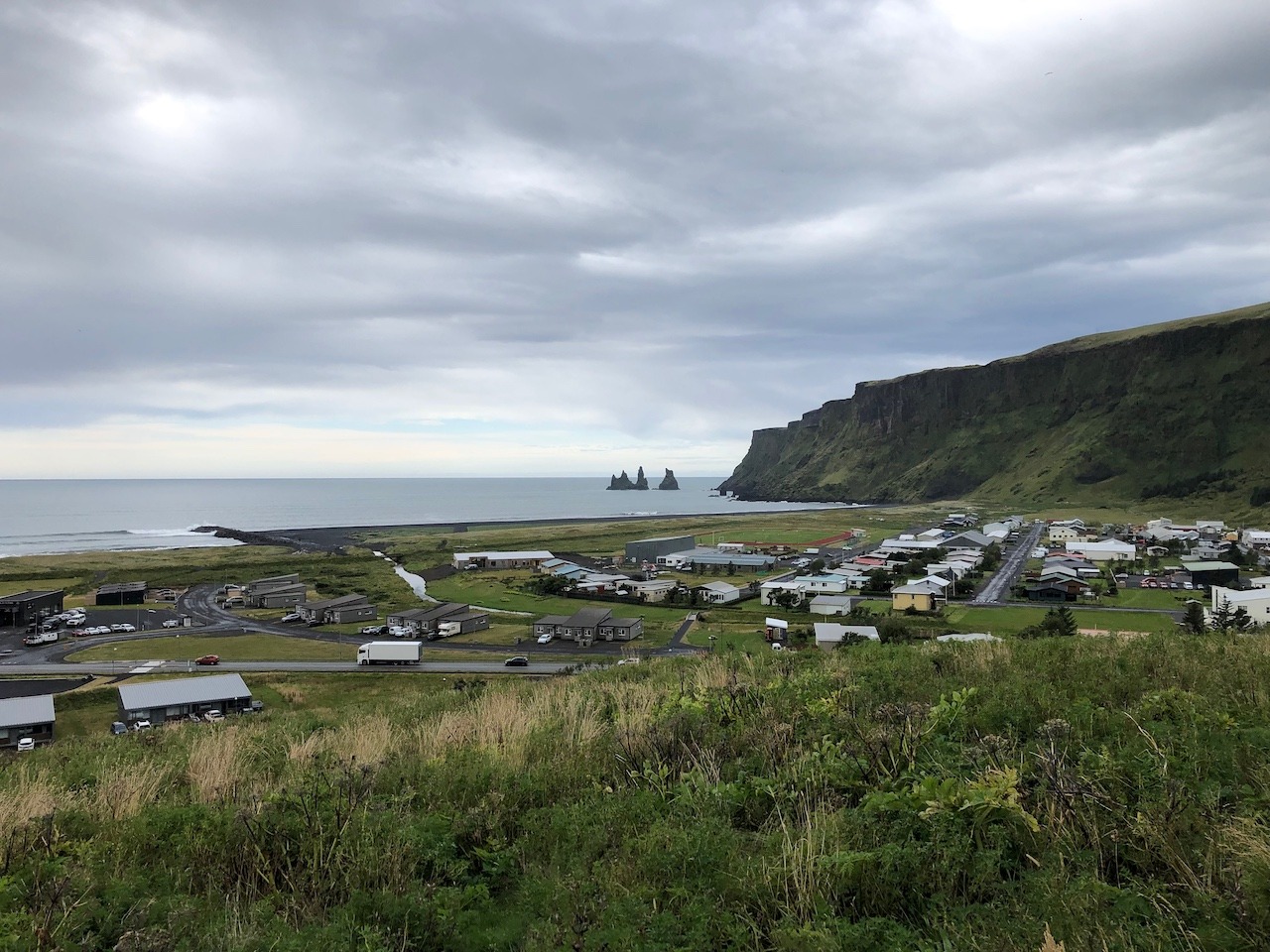
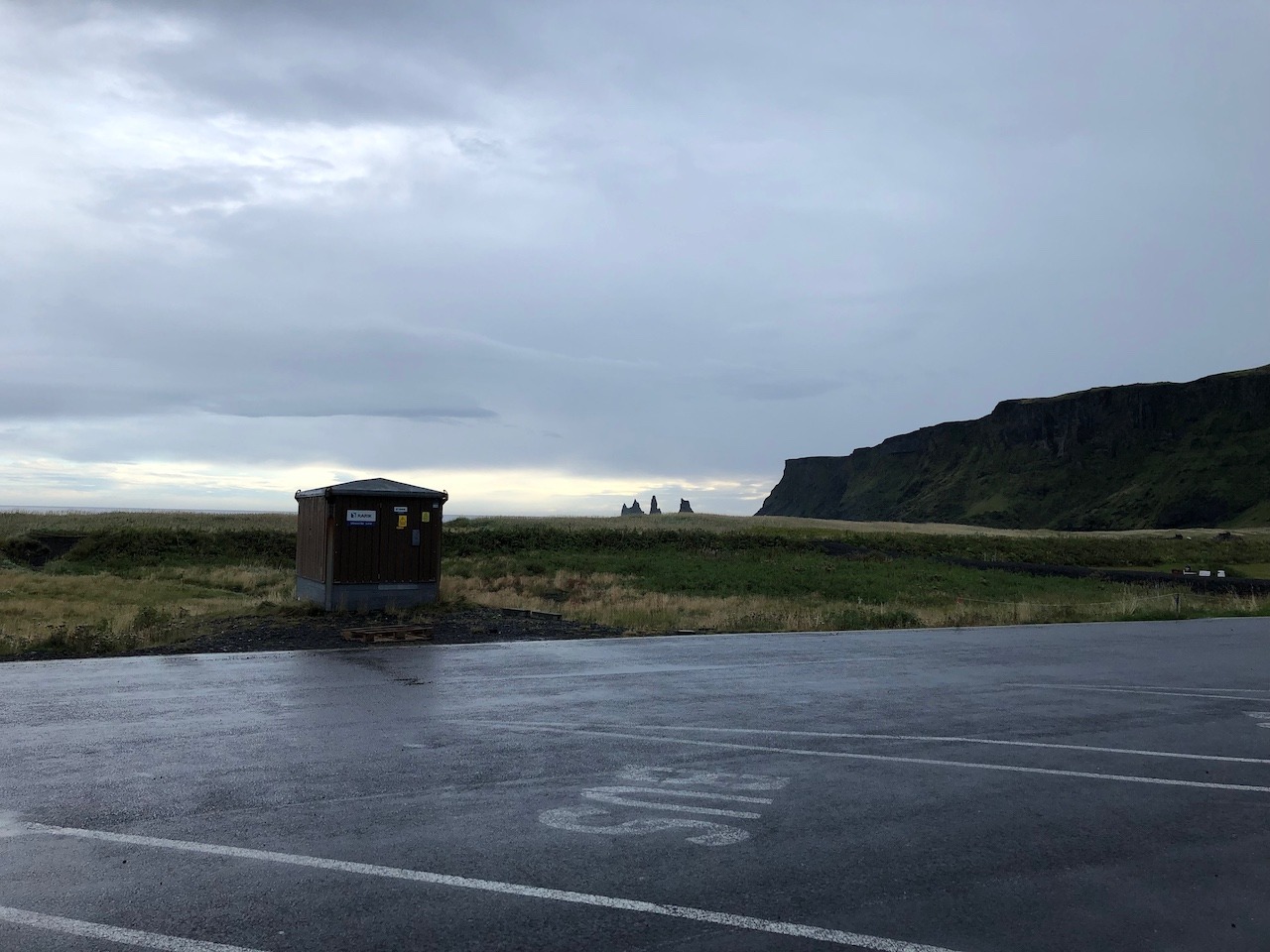
Reynisdrangar in the distance (one of the stacks is obscured)
There are differences in the particulars, however. First of all, the trolls aren’t hauling in the ship. The troll-woman was calling out to the crew, unable to reach them. Additionally, it wasn’t the sun that turned the trolls to stone. Rather, it was the troll-woman’s curse, which the prince then partially reflected back onto her and her companion. This explains why the ship ended up as a stone pillar along with the trolls.
Based on the tale, we can determine which sea stack is which. Langsamur is the prince’s ship since it’s furthest from shore and its three pillars are like masts. According to Jónssonar’s manuscript, two of Langsamur’s pillars used to be connected at the top and thus resembled a sail. Its name (“Slow”) may also serve as a joke, since it was too slow to escape the troll’s curse and now it can’t move at all. Skessudrangur is already named for the troll-woman, but we also know it’s her because she’s positioned nearer to the ship. As for Landdrangur, he must be the pillar closest to shore, as he was following the troll-woman.
A view from a lower spot in town
Reflections
Certainly, such stories serve as a way to explain unique geological features that weren’t fully understood by people of the past. Wonder and mystery could be channeled into the creation of origin stories, forming part of a folkloric tradition. Beyond this, such stories can be viewed through an archetypal lens. For example, given that trolls often represent the untamed forces of nature, this tale could be seen as a struggle between the natural world and the man-made world embodied by the prince. For a different point of view, we can consider the traits of the two female characters: the passivity of the bride, which the prince embraces, and the forcefulness of the troll-woman, which the prince rejects – thus causing stagnation for all involved. There are often many ways to view folklore, and thus many meanings to be discovered.
The legend surrounding Reynisdrangar illustrates how the environment and folklore can intertwine in Iceland. There is a rugged beauty that captivates, and it’s not hard to imagine trolls and other mythic beings shaping the land. However the sea stacks were created, they add to the striking scenery of Vík.
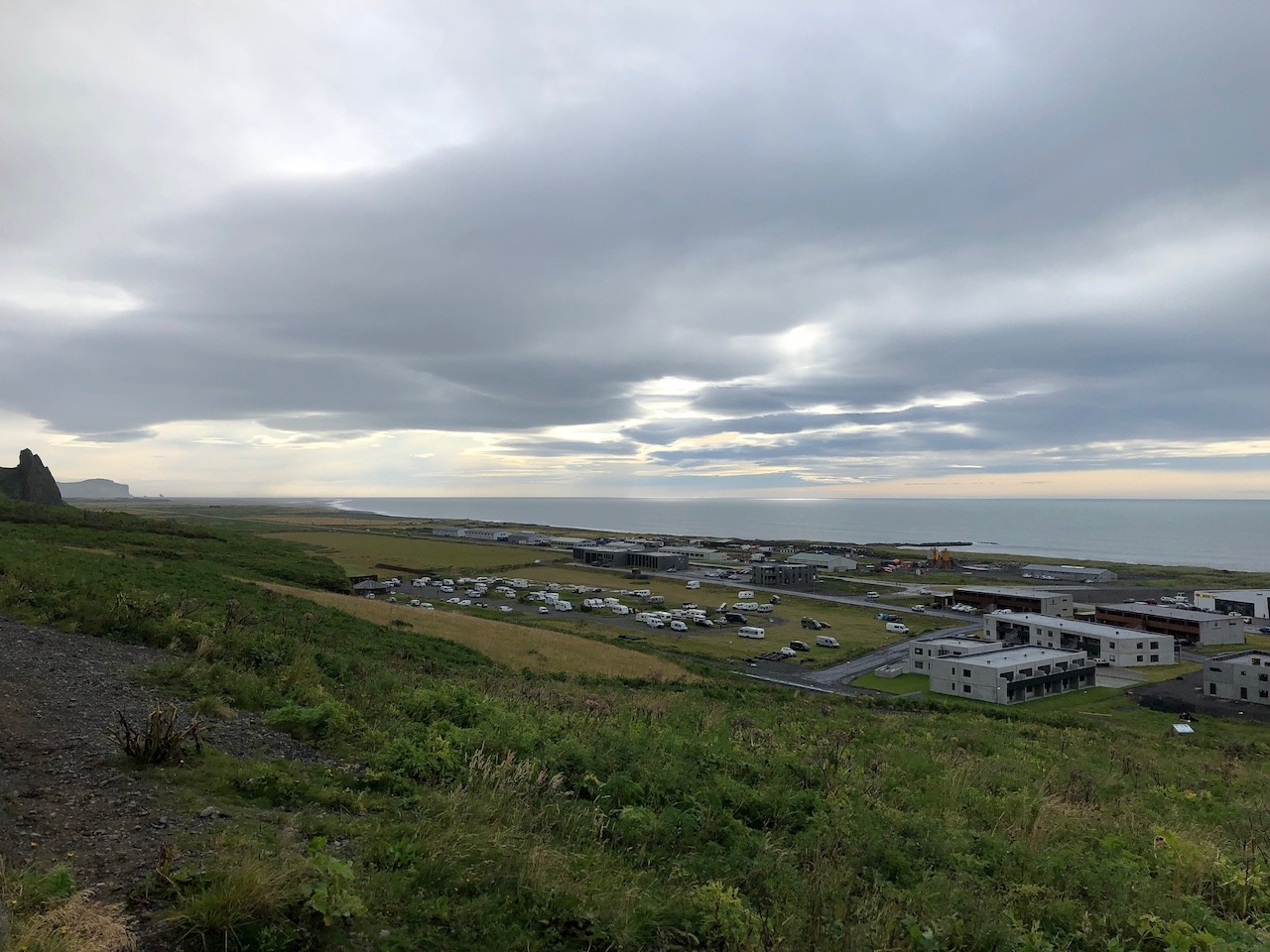
A view of the rest of the coastline
Location
Reynisdrangar can be viewed from various spots around Vík, Iceland.
While visitors today apparently don’t need to worry about trolls at Vík, they do need to be cautious of dangerous “sneaker waves” that can pull people out into the freezing sea. It’s also notable that the town sits at the base of a glacier-topped volcano that’s apparently overdue for an eruption. If that were to happen, residents are trained to evacuate to the hilltop church to avoid a flash flood from the melting ice. (It was from this spot that I took some of my pictures.)
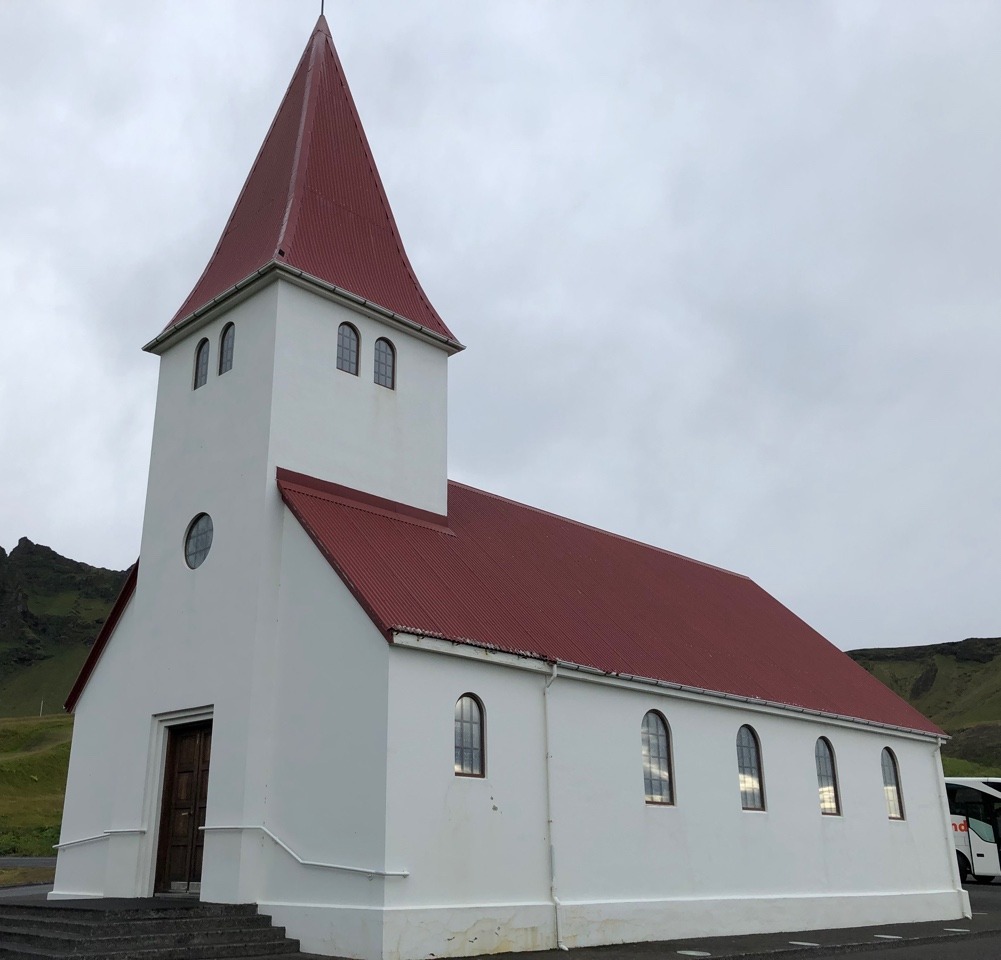
The hilltop church
View Sources
Jón Þorkelsson. Þjóðsögur og munnmæli: nýtt safn. I. Iceland: Kostnaðarmaður Sigfús Eymundsson, 1899. https://www.google.com/books/edition/%C3%9Ej%C3%B3%C3%B0s%C3%B6gur_og_munnm%C3%A6li/jOIOAAAAQAAJ.
Lawless, Jill. “In volcanic Iceland, eruptions bring risk, and tourism boom.” New Jersey Herald, Nov. 21, 2016. https://www.njherald.com/story/business/2016/11/21/in-volcanic-iceland-eruptions-bring/3100900007/.
“Warning: Reynisfjara black sand beach is dangerous.” Visit Iceland. https://www.visiticeland.com/article/reynisfjara-black-sand-beach-is-dangerous.
Written by A. P. Sylvia